5 Pillars of Results Management
Results Based Management is GREAT — when it's done right. Here are the five pillars of practical RBM.
The Results Chain: A Beginner's Guide
Understanding what results are and how to distinguish between different levels of the results chain is fundamental to good M&E practice.
Measuring Policy Advocacy
Monitoring policy work is tricky. But it doesn't have to be impossible — and it can certainly be useful.

How to Formulate Strong Outputs
Outputs aren't the most important level of the results chain — but formulating them well still matters enormously.
Five Tips for Good Report Writing
Fed up with writing long reports nobody reads? Good reporting isn't that hard. Here are five tips for writing stellar reports.

The 5-Step Guide to Measure Impact
You've been working on a brilliant initiative, and someone asks: but did it actually work? Here's how to answer that rigorously.
7 Principles of a Theory of Change
A good theory of change is more than a diagram. It is a living, testable set of assumptions about how change happens.
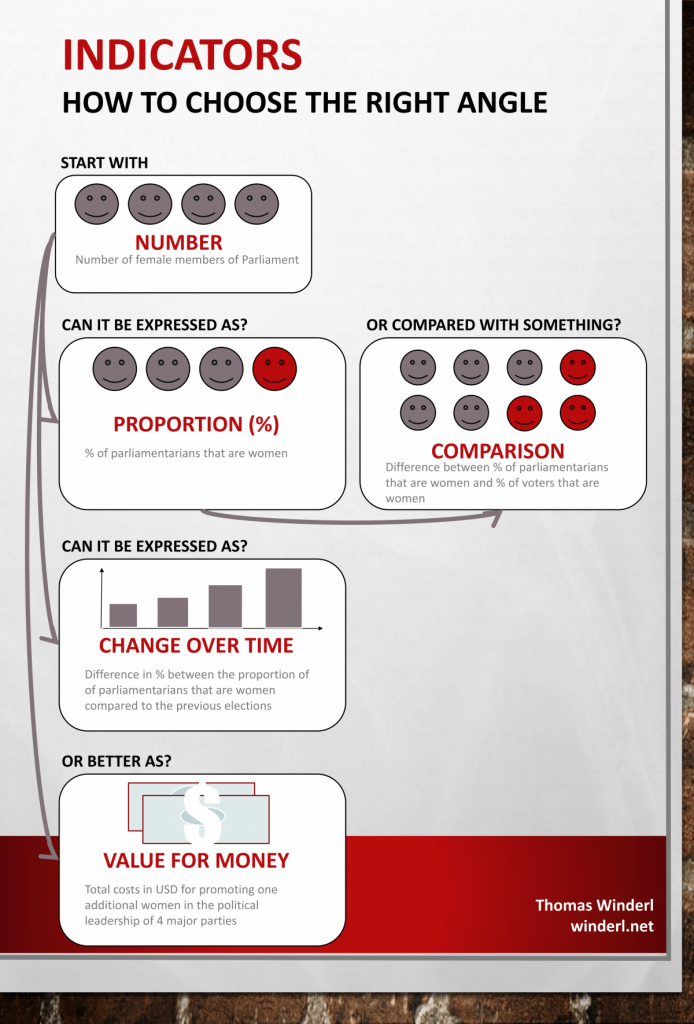
Indicators: Choose the Right Angle
Once you've agreed on a limited set of indicators, the real challenge is choosing exactly how to measure each one.
Stop Overthinking: Minimum Viable Product
An MVP is a product with just enough features to gather validated learning. M&E practitioners should embrace this thinking.

Use Change Language in Reports
An engaging report uses change language instead of action language. Simpler than it sounds, more powerful than you'd think.
Monitoring? Evaluation? Isn't it the Same?
The fact that M&E often goes together is somewhat misleading. They are distinct disciplines with different purposes.
A Theory of Change
Many Theories of Change are often useless — because they are not developed in a logical sequence. Here is how to do it right.
Innovative Programme Design
M&E is strongly linked with good planning and design. Here are eleven options for innovative programme design in complex settings.
The Age of Data
Professional M&E is based on hard facts: data, information, knowledge and understanding. Let's unpack what each one means.
Our Toolbox for Primary Data Collection
To collect primary data, we can rely on a sophisticated toolbox from social sciences developed over decades.
Measuring = Reducing Uncertainty
In M&E, we should aim to be roughly right — not precisely wrong. Even an imprecise measurement reduces our uncertainty.
Indicators in the Age of Open Data
In the age of open data, indicators must be clear, credible and proportional. It is a game changer for M&E.
Seven Steps to Measure Results
A practical seven-step framework for measuring results — from defining what you want to know, to determining measurement instruments.
We Can (Nearly) Measure Anything
"You can't measure everything!" — A common misconception. If we can observe a thing in any way at all, we can also measure it.
What Real-Time Evaluation Can Do For You
Instead of waiting for a final evaluation, real-time monitoring lets you quickly try what works — and what does not.
Innovation in Development Evaluation
Development aid is changing rapidly. Development evaluation needs to change with it. Why? And how?
M&E Needs to Change. We Need to Change.
M&E is undergoing rapid changes. Countries are increasingly taking innovative approaches to monitor and evaluate performance.
Mini Course in Monitoring and Evaluation
New to Monitoring & Evaluation? Join the M&E mini course on Udemy — short, to the point, and rated 4.4 stars by 8,000+ students.
Want to Be a Monitoring & Evaluation Professional?
Do you already work in M&E — or are you considering a career in it? Here is a brief intro into M&E as a profession.
UN Development Assistance Frameworks, Brand New
The new UNDAF guidance is here. An initial review — what has changed, and what falls short.